
e
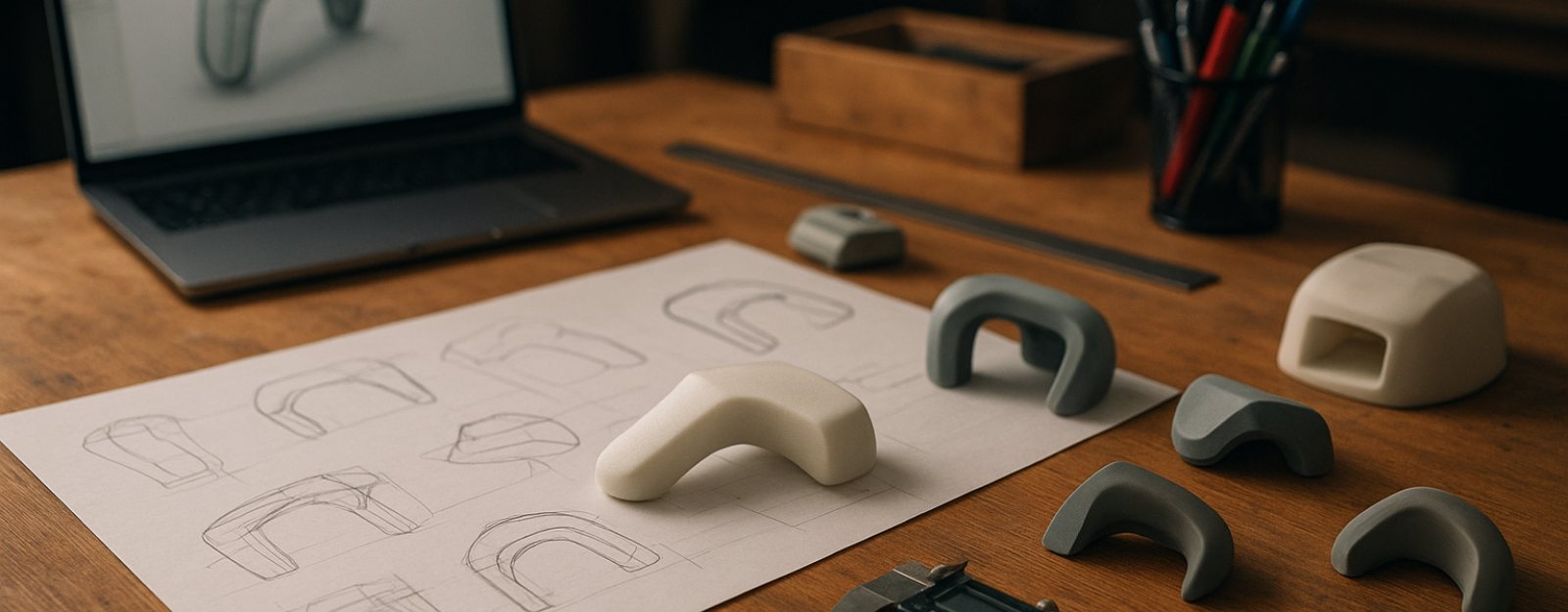
Hardware is the New Salt: Designing with Purpose in the Age of AI
Better things, made smarter
Editor's Note: This is the first essay in a new series exploring how AI is transforming the way physical products are imagined, designed, and built. Hardware is the New Salt will spotlight several thinkers and makers at the intersection of AI and product design and their insights into this dynamic technology ecosystem. This series is supported by Enzzo, who offers an AI-first product development platform created to support the next generation of builders.
 Nichole Rouillac, Founder & Creative Director, level
I've spent my entire career designing hardware—not because I find it easy, but because I love it. There's something deeply satisfying about solving physical problems, prototyping, testing on real bodies, and refining through hands-on experimentation. That process—filled with ergonomic tests, sketches, and mockups—is still, in my view, irreplaceable.
I've tried tools like MidJourney and Vizcom. They're fun, even entertaining. But they don't get to the heart of what makes great hardware design meaningful. When it comes to creating products that fit the human form, perform reliably, and stand the test of time, we need more than rendered imagination. We need craft, insight, and iteration. AI can't replicate that—not yet, and maybe not ever.
It can help offload the tedious parts. I run a design studio, and part of that involves writing emails, marketing blurbs, and proposals. AI helps me get through those tasks faster so I can spend more time where I belong: sketching, prototyping, and solving the hard problems. That's been the biggest benefit—not automation for its own sake, but creative rebalancing. AI gives me back time to focus on what I love most.
That mindset extends to my team. They're younger, they're inquisitive, and they do experiment with AI tools. But while these explorations can be fun, and occasionally surprising, most of what's generated still doesn't meaningfully advance our design process. Our work requires precision, insight, and physical iteration—things AI doesn't yet offer in a reliable or integrated way.
What DOES excite us, though, is how AI is showing up in the hardware our clients are building. The real opportunity isn't how AI helps us design—it's how it's enabling new tools in the world. We're working on products that assist doctors with remote therapy, enhance diagnostic tools, and support patient care in new ways. That's the kind of application that gets us out of bed in the morning.
That's where AI has a real impact.
There's no question that AI makes specific tasks faster. Photoshop's generative tools, for example, have saved us hours. Text-to-CAD tools are evolving too, and we're often asked to test early-stage versions. But while some of these tools can help generate a part or pattern, they aren't yet robust enough to create complete, production-ready CAD models.
Speed can be valuable, but it also comes with risks. I see this moment a bit like the "slow food movement" in response to fast food: just because we can go faster doesn't mean we always should. We've had clients tell us other studios underbid us because they're using AI to crank out concepts. But our value comes from the quality of what we deliver. Some of the products we've put into the world have defined entire categories. I won't jeopardize that by outsourcing thinking to machines.
Designing something meaningful takes time. Time to explore. Time to reflect. Time to get it right. And when you're working on products that could literally change lives, or save them, you don't take shortcuts.
Trust is another critical piece. Many of our clients—from startups to tech giants like Microsoft and Google—require airtight confidentiality. We're audited, vetted, and take those responsibilities seriously. When a startup asks us to try their cloud-based AI tool, my first question is always: How secure is it? Who has access to our data? How do I know this isn't a leak risk? In many cases, we can't take that chance. The stakes are simply too high.
That doesn't mean I'm anti-AI, far from it. I'm genuinely excited about the innovation happening in this space. But especially in hardware design, the tools just aren't mature enough—yet. They'll get there, and when they do, I'll be the first in line. But for now, we maintain a healthy skepticism, especially regarding IP and security.
One of AI's big promises is speed. With speed comes the ability to produce more. But do we really need more products?
We're already drowning in landfill-bound goods. I live in California where I've seen the impact of climate change firsthand—the fires, the smoke, the devastation. More isn't always better. In fact, I'd argue that less, but better, is what the world truly needs.
I've noticed that tighter budgets during economic downturns have actually improved the quality filter. We're seeing fewer frivolous projects, and more thoughtful innovation. And that's a good thing. We should be asking ourselves: is this product necessary? Will it improve someone's life? Or is it just another piece of junk with a carbon footprint?
The goal shouldn't be more things faster—it should be better things, made smarter.
I love the title of this series—"Hardware is the New Salt." Because it's true: you can't live without it. Software may be eating the world, but it can't exist without hardware to run on.
Every major technological shift—from the Industrial Revolution to the rise of personal computers and wearable tech—has been rooted in physical product innovation. Software has amplified that, but hardware is still where the real transformation happens. You can't revolutionize healthcare with an app alone. You need sensors, devices, and form factors that work in the real world.
We build those things. And that's why I'll keep showing up, sleeves rolled up, ready to sketch, test, and build the next thing that matters.
Here's a short clip if Nichole discussing some of these ideas:
Enter a caption (optional)
About the author Nichole Rouillac is the Founder and Creative Director of level, a women-led industrial design studio in San Francisco. She leads with a mission to create intelligent, thoughtful designs that shape industries and enhance lives. Her work has propelled breakthrough products into the global spotlight, with an award-winning portfolio that includes Microsoft, Google, Logitech, Fitbit, HTC, AliveCor, Nex, and Tempo.
level's impact has been recognized with top accolades, including IDEA Gold, Red Dot, iF, and Spark Platinum awards, as well as Fast Company's #3 Most Innovative Design Company.
Nichole has also been a Core77 Design Awards Jury Captain (2022) and Jury Member (2024), while level has been an honoree several times, including the winning entry in the 2024 Gaming Accessories category.
Beyond design, Nichole is a dedicated advocate for diversity in the industry. As the former chair of IDSA's Women in Design, she mentors and champions the next generation of female designers, helping to reshape an industry where women remain underrepresented.
-
o7Favorite This
-
Q2Comment
Directory Company Profiles

Core77
Industrial Design
Resources
Industrial Design
Resources
-
Core77 Directory
Find the Best Industrial Design CompaniesGo -
Hatch Duo, LLC
Founded by an award-winning team with over 20 years of combined product design experience, Hatch Duo...
-
ECCO Design
ECCO Design is a full service product design and innovation firm. We are a team of designers, resear...
-
andesignlab
ANDESIGN is an industrial design consultancy based in Orange County California and Austin Texas. AN...
-
DesignStein Studios, LLC
We are a team of industrial designers focused on developing products that are intended for tooling a...
-
Bluemap Design
BlueMap design is a multi-disciplinary product development firm. Founded by Simon Yan in 2001, the f...
-
Fahrenheit Design
Fahrenheit is an award-winning product design and innovation firm based in Austin, Texas. Since 2002...
-
RMT PRODUCTS LIMITED.
RMT PRODUCTS CO. , LTD. provide on-time delivery, high-quality prototyping and manufacturing . It i...
K
{Welcome
Create a Core77 Account
Already have an account? Sign In
By creating a Core77 account you confirm that you accept the Terms of Use
K
Reset Password
Please enter your email and we will send an email to reset your password.
Comments
Thanks for sharing and agree to your thoughts! As AI and software development evolve at lightning speed, it's easy to overlook the foundation that makes true innovation possible, Hardware Design. The future of intelligence isn't just about the code, it's about the silicon, the custom chips, and the data-centric architectures we build them on. Hardware is the "salt" that brings intelligence to life—it defines the efficiency, speed, and sustainability of every AI model we deploy. We can't solve the world's toughest problems with software alone. Purposeful hardware design is now at the heart of innovation, determining:
The claim "It's just the beginning, it'll definitely get better later" has already admitted to be a lie by the very company at the forefront of the hype, OpenAI. ( https://www.computerworld.com/article/4059383/openai-admits-ai-hallucinations-are-mathematically-inevitable-not-just-engineering-flaws.html ) If the only thing you can point at and say it can do is "make things cheaper because we can pretend the experienced and skilled labor fixing all the mistakes it makes aren't actually doing as much work so we can pay them less" then you have not actually created anything of value; you have just given the C-suite a sop to extract more wealth because I guarantee no prices will be reduced anywhere.